Sunday, December 13, 2009

Jizō-in


"This is what I want to to take home with me."

Saturday, November 28, 2009

"Explain Thanksgiving? Basically we eat a lot."


Being far away from home and perpetually culturally confused this semester motivated me to pour lot of emotional energy into Thanksgiving. Finally a custom I can wrap my head around!

On the menu:

Chicken (Megan's contribution)
Pinapple-Cheddar Casserole (ditto)
Simmered Pumpkin (mine)
Fried Potatoes (also mine)
Classic Green Bean Casserole (Cailyn)
Chocolate Cake (Emily)

Caught up in the Thanksgiving frenzy, I took a bit of a detour on my way to pick up my groceries after class. By "bit of a detour" I mean a bus ride to the giant 100円 (dollar store) near Hirakata Station. I was looking for a tablecloth and centerpiece but since I found neither, I went overboard with glasses, placemats, and candles instead.

For decoration, I gathered up some leaves in the park across the street. If you're ever in the mood to be stared at by 20 people at once, go to a Japanese park and start picking up leaves off the ground. Perhaps they thought I was tidying up? Who knows? I was too enthused with the spirit of Thanksgiving to worry about it.

The food was of course outstanding. Japan doesn't really "do" turkey unless it's ground, but if you slap a bit of cranberry sauce on some chicken breast you get a somewhat Thanksgiving-esque effect. My pumpkin served as a nice sweet potato substitute and Cailyn's casserole was the real-deal. Substituting Ritz crackers for the French's onions only improved the dish in my opinion. The real surprise of the evening was Megan's pinapple cheese casserole. Not one of us thought it sounded like a remotely good idea and not one of us was able to resist additional helpings. As for dessert, there is always room for chocolate cake (generously donated by Emily's parents), no matter how many pounds of side-dishes I contain at the time.

All-in-all we made way too much, ate every bit of it, and spent the remainder of the night unable to move, let alone study.

Friday, November 20, 2009

Monkeys and Maple Leaves


Cailyn, Megan, Emily, and I went to Arashiyama (western Kyoto) today. We saw many famous places and did many spectacular things.

Spoiler: I kicked a monkey.

The beautiful Arashiyama area is home to Japan's semi-famous "Monkey Mountain." At the top of the mountain, there's a beautiful view of Kyoto. There are also, as one might imagine, lots of monkeys, which do monkey-like things. Their primary activities seem to include picking insects off each other and being photographed by tourists, which leads us to...

THE GREAT MONKEY DEBACLE:
While I was taking one of several hey-look-at-that-cute-monkey photos, another monkey came and, unkown to me, sat at my feet. When I lowered my camera and started to walk, I kicked the monkey. Yes, I KICKED a MONKEY. I'm told it jumped several feet in the air and ran off, shooting me what my friend described as a "DUDE, what the hell?!" look over its shoulder. I did not see this expresion because I was busy hiding my face from as many as six Japanese people who were staring, open mouthed, at me like I'd punted the unfortunate creature off the side of the mountain.

Needless to say I got off that mountain as fast as I could, lest the monkey (or the Japanese people) had a chance to plot revenge.

After a short walk on the other side of the river, we reached the temple Tenryu-ji, a prime maple leaf viewing spot. The path leading away from Tenryu-ji runs through Japan's most famous bamboo forest.

It seems "famous" is Japanese for "crowded."
We then made our way back down to the Arashiyama bus stop and eventually back home. On the walk back from Makino Station, Megan stopped for Taiyaki. The friendly taiyaki salesman gave us all a "bonus" taiyaki, presumably because it was late and they won't keep overnight--a surprise ending to a lovely, if at times embarrassing, day.

Tuesday, November 3, 2009

Tetsugaku no Michi


Emily, Megan, and I spent the first cold day of fall walking the canal-side "Philosopher's Path" in Kyoto. In about two weeks, all those trees will be flame-red. Guess our timing could have been better, but today was Culture Day and there were no classes. It was a good day to explore. Besides, my cold, stiff fingers gave me enough of an autumn experience to make up for the decidedly green foliage.

Monday, November 2, 2009

Asuka by Bicycle


A field trip with my art history professor. Rural Japan at its finest. 7th C. Japanese sites at their finest. Autumn weather at its... let's go with "warmest" and leave it at that.

Wednesday, October 21, 2009

The Great Kabocha Adventure

While it's not technically the week before Halloween yet, I wanted something nice and American to do with Misato when she came to visit the Seminar House right before my midterms kicked in.

The perfect solution: jack-o-lanterns!


Part I: The Great Kabocha Purchasing Adventure

Of course, in order to carve jack-o-lanterns, I had to first buy some pumpkins. While your run-of-the mill Halloween pumpkin is almost impossible to find in Japan (I did find two at a florist, but they were $30 a piece. I don't think so!), the Japanese eat a lot of pumpkin. You can buy a Kabocha (Japanese cooking pumpkin) in just about any Japanese grocery store... in four pieces! That's right. It seems to be standard practice to quarter one's Kabocha before selling them. But surely some stores offer whole pumpkins, right? Wrong. I went (by foot) to eight (count 'em, EIGHT) supermarkets AND a produce market without success.

At the last of the eight supermarkets, about half an hour before I was supposed to meet Misato, I decided to buy some solid but somewhat pumpkin-shaped squash and hollow them out with a melon baller. As I put the squash in my basket, I noticed that the labels sealing the wrappers on the adjacent Kabocha bore the logo of the particular store I was patroning. Never before has anyone so fervently hoped that a market (super or not) quarters its pumpkins on site!

After a conversation with a produce person which was both longer than it should have been and grammatically awkward (Have YOU ever mimed the act of quartering a pumpkin? Turns out the word is スライスする for the Japanese-speakers among you), the aforementioned produce person ran (literally) to the back and returned with two, large-ish, blissfully intact Kabocha!


Part II: The Great Kabocha Carving Adventure

On the way to the Seminar House, I gave Misato a general overview of the pumpkin-carving procedure. She said it sounded a bit dangerous, but I assured her that in a lifetime of annual

pumpkin-carving fun, I'd never once cut, burned, or otherwise injured myself.

Once we got back, within 30 seconds of picking up the knife, I sliced my finger open and bled all over the floor, sink, and everything in between. Smooth, no? Fortunately, Megan had agreed to join in on the seasonal fun, and Megan's first aid kit comes with gauze. She patched me up nicely and it was determined that my cut wasn't serious enough to need stitches. I guess a little gore fits in nicely with the Halloween theme.

A few paper towels later, we were underway again and having quite a good time. Megan brought some American candy to enhance the cultural experience and we began carving. The smallest knife I could find was rather large and the pumpkins were rather small, so we went with a traditional pattern: triangle eyes and a toothy-grin. Since the Kabocha were bred for eating, not for carving, they were quite thick-walled. That made it hard to get the tops off, but, surprisingly, didn't cause much trouble after stage 1. Having benefited from my awesome display of this-is-how-definitely-NOT-to-do-it, Misato carved her pumpkin very adeptly. She clearly enjoyed herself, which made all the trouble absolutely worth it, since I owed her a good time after the great visit I had with her family. She also got to meet a lot of other Sem. 1 residents, who wandered over to watch the project unfold. Since she's been wanting to get to know some more international students, the day was a success on all counts.


Part III (Epilogue): Added Kabocha Benefits

1. I sautéed the leftover eye- and mouth-shaped chunks in sake, sugar, and soy sauce and had them for dinner. Freakin' delicious! So much so that I went out and bought one of those dreaded Kabocha-quarters to eat later this week.

2. Roasted pumpkin seeds. Also freakin' delicious.

3. Since I've been lighting my jack-o-lantern up in my room, it smells like roasted pumpkin now. While that makes me a little hungry at times, it also gives the place a warm, cozy feel.


Couldn't have asked for a better out-of-country (or in-country for that matter) Halloween!

Saturday, October 10, 2009

Tanaka Family

Two weeks ago: "[Stay tuned for an exciting piece of text to accompany this photo!] "

Oder auch nicht. Okay so I'm an... inconsistent blogger. Should have seen that coming, no? Rather than try to play catch-up, though, I'm just going to start off where I am now. Well... maybe just this once:


The delightful young lady above is Misato Tanaka, my "Home Visit" partner. The small, distracted one in her arms is her niece, Airi. I spent a long-weekend/holiday with Misato's family recently. Misato, her parents, and her sister were all overwhelmingly welcoming. We did some sight-seeing in their hometown of Nara and took a day-trip that included an unexpectedly long (4 hours each way) drive. There was holiday traffic galore. The car was a great place to chat though.

After I tried, and probably failed, to explain American healthcare reform to Misato's father in Japanese (let's just say the conversation involved miming and me taking out my insurance card), her sister, Sayo, taught me Airi's favorite nursery rhyme. It's called "Zou-san" ("Mr. Elephant"). I've been practicing, which either hilarious or sad. I can't decide which! In an eerily perfect display of reciprocal cultural exchange, I taught them "Twinkle, Twinkle Little Star" in return.

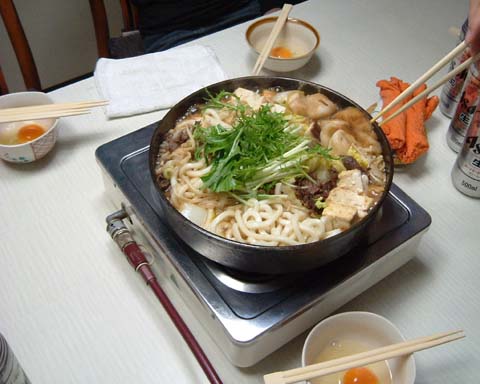
There was, of course, also some amazing Japanese cooking. We 20-somethings made dango, round, sweet balls made of rice flour and tofu among other things. Misato's mother made sukiyaki for dinner one night. Dear lord was it good. It's basically a bunch of vegetables cooked with strips of beef in a big pot. You pull the lovely little morsels out and dip them in egg before eating.

Here's hoping they invite me back!

Thursday, September 24, 2009

Fushimi-Inari Shrine

Recently, I made a day-trip to the Inari Shrine, located in Fushimi, which is a suburb of Kyoto that conveniently lies on my rail line. Inari is the Shinto god traditionally associated with grains and harvest and is now believed to influence profits--the harvest of the modern world! For this reason, countless orange torii (gates), donated by Japanese businesses, line the paths winding above the main shrine through a beautiful mountain forest.


I particularly enjoyed going to the shrine alone--whether the people living in my Seminar House believe me or not ;-). I developed bit on an artistic obsession with the bells hanging in the sub-shrines that dot the mountain and burned up hours photographing them.


Kyoto, about half an hour away from Hirakata by train, makes for lovely day-trips, so I plan to go to many more temples and shrines in the weekends to come. I'm quite glad to be situated so close Japan's most historic city and worry only that I might burn myself out before I get to see some of the spectacular places I'm saving for maple-leaf season. The city itself is a rather fascinating mixture of old and new: an urban core surrounded by pristine mountain temples and shrines. It's also one of Japan's centers for ceramics artisans (my ceramics professor at KG is trained in the Kyoto style), so I'm hoping to score the perfect tea set during one of my visits. Fingers crossed for the flea market at Tou-ji temple in November!

Sunday, September 6, 2009

First impressions... and then some!


Now that my over-scheduled week of orientation is coming to a close, I'm starting to settle in... to both the Seminar House and the country.

Some things I like about Japan thus far:

1. Food. Buying it, eating it, cooking it! Never has going to the grocery store been so much fun! I spent an hour in there yesterday, and the time flew by. I'm glad I finally have full kitchen privileges and can start to trying out some more complex dishes. I've found the food here both delicious and cheap, especially in the school cafeteria, where little old Japanese women serve up some wonderful food to an assortment of Japanese and foreign students.

2. Punctuality. Trains run on time; orientation sessions run on time; I have a feeling that even Japanese babies are always delivered on time.

3. Rail transportation. It's easy and cheap to get to Kyoto (0nce you've done it once before). It's a good thing too, because I have more sights there than I can count marked in my guide book for future visits!

Some things I don't like about Japan:

1. Narrow streets and reckless drivers. Actually, I find the narrow streets in Hirakata's residential neighborhoods quite charming, but I arrive at the university everyday somewhat surprised that I wasn't run over on the way.

Some things I like about the Seminar House (SH):

1. Outside the SH, I have a very strong feeling that I don't fit in, which is kind of the idea of living in a country with a culture quite different than one's own. Nevertheless it's nice to go back to a place where I very much DO belong. It's astounding how like me my Swedish roommate seems after a day of navigating unmarked streets and following the directions of old ladies I can barely understand.

2. My room (above). I find it delighful! The table could use a plant though. Technically, I'm contractually obliged to keep my room clean, including "putting futons away every morning," but I think I'll leave mine on the floor anyway. KG should be proud they got me to make my bed at all! I get the impression that nobody follows that particular rule anyway. (Note: the cloth hanging on my wall was a beautiful gift from my speaking partner, "Ken" [Kensaku].)

Some things I don't like about the SH:

1. The pillows are quite firm. Ever rest your head on a block of wood? Feels as though I do every night.

2. Having to change my slippers to use the bathroom. This is such a small thing, but I hate it. I really do.

3. The way the kitchen smells. I'm hoping this will improve now that the homestay students have moved out and there'll be 1/3 less trash.


All in all though I'm having quite a good time adjusting. Guess there's nothing to do now but wait and see if culture shock kicks in!

Wednesday, September 2, 2009

Typhoon Troubles

After a typhoon passing over Japan caused me a rather hellish ordeal (a 5-hour delay in Detroit, my connection flight to Osaka cancelled in Tokyo Narita, insanely long lines, and a re-booked ticket out of another Tokyo airport I couldn't get to... a fact I established only after a difficult conversation in Japanese with a very understanding employee of the Tokyo subway system), "Northwest," now operated by Delta, finally gave in and bought me a very nice hotel room with a lovely view (below)!

After a much-need good night's sleep, I got on an hotel shuttle to Haneda Airport and flew from there to Osaka, where the university picked me up.

Excrutiatingly long story short: I made it!


Here's the more detailed email I sent to my parents from the hotel room:

Want to hear about my day? Sure you do!

Long story short: Typhoon caused delays and cancellations and I'm at a hotel room Delta bought me in Tokyo.

Long story long:

1. Boston --> Detroit
Uneventful. NW has merged with Delta, so that took a while to figure out. The only place I saw the word "Northwest" today was on my ticket.

2. Detroit --> Tokyo (Narita)
Flight was delayed for 5 hours because of a typhoon that closed down the Tokyo airport. I got very familiar with the terminal at Detroit, which is HUGE and quite snazzy. Slept for about 10 hours on the plane. I had a whole row to myself, so I got to stretch out and use all three seats like a bed.

3. Tokyo --> Osaka
After arriving about 5 hours late, problems arise. We were told we should be able to make our connections, since they were delayed by the closing too. However, as soon as the Tokyo airport opened, the typhoon shut down all the airports in Osaka. The back-up got so bad (just imagine how many flights there must be from Tokyo to Osaka daily) that they just canceled all the flights and told us to go through customs and re-book at the departure gate.

4. Re-booking
After I got through customs, I encountered a VERY long line of EVERY Northwest and Delta customer to go through that airport today in either direction. I was in it for 3 hours, and had a nice chat with the family in front of me. When I got to the counter, I was told that all the flights to Osaka were full until TOMORROW night (ie 24 hours from when I was talking to the very nice ticket people who looked like they wanted to quit). That would be too late for a pick-up from Kansai. They could get me there at 8:30 am if I left from Hanada airport, which is on the other side of the city, but which is subway accessible.

5. Getting to Hanada... NOT!
When I went to buy my subway ticket, I learned (eventually... the ticket guy didn't speak any English and my Japanese is only one step above worthless) that the next train to leave the airport was the last one, and that I wouldn't be able to make the connection I need to get to the Hanada airport. I went to the bus counter and learned that the last bus for Hanada had left hours earlier. I felt really good about my Japanese-interaction with the bus girl though. This level of Japanese I could handle. "Can one take the bus to Hanada from here?" "When is the bus to Hanada?" "When is the bus to Hanada tomorrow?" "When does that bus arrive at Hanada." The answer: too late for my 7:30 am flight. And a taxi would cost me $300. Apparently Hanada was far away.

6. Re-re-booking
I went back upstairs to the departure desk, where the line had shortened to a 15 minute wait and got my re-booking changed to 11:30 so I could get to the airport on time. This took a while since the agent was constantly interrupted to help passengers who actually had a chance of getting to their original flights. Eventually though I got my new boarding pass, which was stamped with "involuntary reroute." No kidding. The good news: in the time between my first re-booking and my re-re-booking, Delta had decided to issue Hotel vouchers for passengers stranded overnight.

7. Getting to the hotel
I was told to go downstairs to the Delta arrival desk (just outside of customs) to get my hotel voucher. Since they were doing re-booking there too, the line was really long. I asked someone who looked like he was in charge whether I had to stand in line to get the voucher if I was already re-booked. He looked at my boarding pass, gave me the name of a hotel, and told me to follow a Japanese TSA equivalent (they were helping out since Delta didn't have enough employees to deal with the hoards of passengers). She put me on a shuttle and I crossed my fingers and prayed that it was going to the right hotel and that my lack of a voucher had been understood. After a 40 minute drive, I started to wonder whether they were taking us all the way to Osaka. Okay, not really, but I was getting nervous. Street signs soon revealed that Narita airport is REALLY far away from Tokyo (and by really far I mean 40 minutes).

8. At the hotel
No vouchers needed. They gave us all (about 20 of us at THIS hotel) forms to fill out that asked for our names, passport number, and airline. Northwest was already filled in. I got a key, a coupon for a free breakfast, and instructions for reserving a seat on the hotel bus to Hanada airport (which is a lot closer from the hotel than it was from Narita) in the morning.

The room is very nice and has a great view! It's a western-style hotel room with an Japanese-style room built in. I've been trying to decide whether sleeping in a nice hotel room in Tokyo rather than a floor in Osaka makes this whole headache worth it. I think I about broke even!

More when I get there!

Eure Tochter

Wednesday, July 29, 2009

Visas and Bureaucracy

I submitted my visa application today. The whole process (including getting to the Japanese Embassy and back) only took me 30 minutes. I completed the entire transaction during my lunch break and still had time to enjoy a bagel. One of the perks of interning in Washington, DC seems to be my office's convenient location down the street from Japan's embassy. Even given my atypical proximity, though, I am astounded by how little time I spent submitting the application. I was in and out of the building in a little over five minutes. I encountered no lines, no waiting, and no raised eyebrows at the fact that none of my official ID photos match. Where is the terrifying Japanese bureaucracy everyone keeps telling me about?

When I approached the Consular Services counter, I was greeted by a pleasant woman with the remarkable ability to be both personable and extraordinarily serious at the same time. She took my documents, immaculately folded my Certificate of Eligibility into my passport, and told me to come back on Friday to pick up my visa. I left the embassy with a claim stub and the vague feeling that if lost it, I'd never see my passport again. Needless to say, I don't plan to lose it.

My admittedly as-of-yet limited experience with Japan's particular variety of "bureaucracy" has me wondering why Americans view it as such a bad thing. Why do they associate the term with red tape rather than the high level of efficiency I've encountered both today and in also infamously bureaucratic Germany? Likely our abhorrence is a manifestation of American individualism; we recoil at the notion that everyone should complete a task in exactly the same manner. We see ourselves as unique individuals, and expect exceptions to be made to accommodate our needs, lest our illusion that we are "special" be shattered. The couple at the window next to me was shocked that the attendant wouldn't photocopy their Certificates of Eligibility, despite the fact that the readily available application instructions state that applicants must bring both the original document and a copy with them, as copying services aren't available at the embassy. I'm just glad they weren't in line in front of me. If conformity gets me out the door in five minutes, I'm all for it.

Granted, it's probably unwise to base my assessment on a five-minute interaction with a single (probably rather Americanized) Japanese official. I guess I'll have to wait and see whether my opinion changes when a significant language barrier stands between me and my local Japanese bureaucrat.